
Swordstack Saturday: The Scottish Claymore
A Short Post on a Long Sword (huehuehueh)

For those who have been following my regular notes, this will not be much longer than those generally are: there is just more media information to convey, and the notes format is inconvenient for what I need to say. Enjoy! This is not a replacement for my normal posts on theological subjects: I expect to have a post available soon on morality and videogames.
This one goes out to Kerr Martin , the Scottish fella who requested information about this particular weapon!
“Claymore” is simply a Gaelic-originated word meaning “great/large sword.” It first came into common use to describe this particular style of large two-handed sword used in the Scottish Wars of Independence, and was in use from approximately the 1400-1600s there: note the distinctive upturned wings of the crossguard (called quillions), which each end in the clover-like quatrefoil.
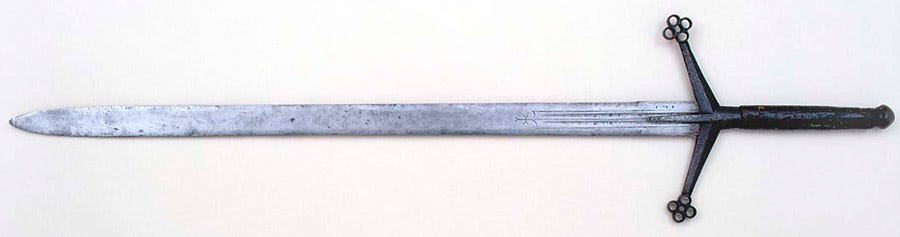
“Greatswords” are a loose category of weapon, typically describing swords with blades close to (or greater than) 4 feet in length requiring the use of two hands, and took different cultural expressions and styles depending on region. Claymores and zweihanders (“two-handed” in German) are probably the most recognizable types due to their presence in pop culture, but there were other variants.
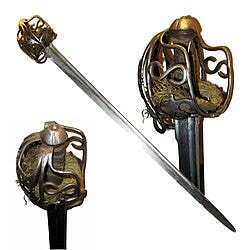
A small clarification: “Claymore” also eventually came to refer to the Scottish single-handed basket hilt sword that came into vogue in the 1700s, though this was also when that style of weapon became popular throughout Europe (and I’m not really talking about that kind because it ain’t the O.G.).
Anyway, back to business. The overall length of a Claymore could frequently be close to six feet, with the blade generally comprising roughly 2/3 of that length. Nevertheless (as described in my note last week), these were not necessarily heavy or unwieldy chunks of steel, as they could often weigh a mere 4-6 pounds.1
Although this is using the zweihander style of greatsword, the information is still applicable here. Note the size and nimble handling of the blade. This is not to say it is easy to wield (after all, the torque of such a long weapon is significant even if the weight is not crazy), but certain fighting styles can get around that.
What advantages would this (and other greatswords) convey? Well, the biggest is obviously:
1) Reach. If your opponent is in danger just from coming within four feet of you (and they don’t have a weapon to match), then that is going to be trouble for them, since you can then effectively act with impunity. You can hit your opponent without being in any personal danger. It is also very useful for squaring off against other lengthy weapons—such as polearms and spears—precisely because it helps to equalize the reach advantage offered by those longer weapons. Additionally, because the weapon is so long, it can be used to
2) Threaten multiple assailants. The other major advantage is in the style of fighting most common for greatswords, often referred to as Montante. This is a style that allows for a single combatant to threaten multiple opponents simultaneously with ongoing fluid motions. Check out this video for how it works: the blade is nimble enough to move around quickly, especially after gaining some momentum. If you combine this with being armored, then even getting a hit through to the user might not be enough.
Yes, I know, they guy is not using a claymore. It is surprisingly difficult to find examples of people sparring with greatswords that are not zweihanders, apparently.
That’s all! Like I said, not an incredibly long post today, as I want to keep these pretty bite-sized. I like the distinctive look of the weapon as a highlander take on the greatsword style, and it was fun to do a bit more research on this national symbol of Scotland (and also to finally learn why two different kinds of swords are referred to using the same word). If you have any questions, feel free to ask and I can do my best! I am not an experienced historian, and I am unfortunately unable to read historical manuscripts in their original language, so it is quite possible that there is information or context that I am missing.
It is surprisingly difficult to find videos of people handling/using claymores in sparring. This video is at least helpful for showing a scale of how it looks when held and used. I don’t endorse the product, necessarily, but it sure looks nice:
Very professional article and informative. If I had stumbled upon it, I would have thought this publication was a historical stack related to weapons.
Thank you for running with my request, sir! I'm glad it inspired such an insightful post, and "long form" too, I'm flattered.
Swordstack Saturdays are quickly becoming my favorite part of the weekend. Now, I must go and rewatch Rob Roy. Amazing pull!